

The ultimate guide to traveling with friends (without ruining the friendship)
Planning a group trip is one of the best things you can do, and one of the hardest. Here's how to travel with friends without the chaos or ruined friendships.

Group trips are some of the best experiences you'll ever have. They are also some of the most chaotic to organize. Here's how to do both well.
Whether it's a ski trip, a beach week, or some half-baked adventure someone pitched in a group chat, traveling with friends is inevitable. And for most of us, so is the chaos that comes with planning it.
Sound familiar?
Take our annual ski trip. Eight friends, same conversation every year: Austria or France? The group splits predictably. Two who live for après-ski, two who want to disappear into a sauna after every run, and a couple who actually want to take lessons this time. We start talking about it in late summer, full of energy. Then somehow, nothing happens. No one wants to be the one to plan everything, so no one does. Winter creeps up, someone drops a resort link in the chat, it gets buried under 400 messages, and half the group stops responding altogether. Planning in the group chat is usually why it never gets off the ground. The people who actually want to go start researching on their own, throwing suggestions into the void. Dates never align. Last year, three of us went. Three out of eight.
And that's just a ski trip, a trip the same group takes every year to a destination we more or less already know — and one where all that waiting has a price, which is its own article: how to make a group ski trip in Europe cheaper. Regular holidays are usually more complex, and somehow even harder to get off the ground.
Traveling with friends is one of the great joys of life. Getting everyone there is one of the most reliably chaotic things you'll ever try to organize. This guide is here to help you do both: have the trip, and keep the friendship. We'll cover everything from the conversations you need to have before anyone opens a flight search tab, to how to handle money without the awkwardness, to what to do when things go sideways mid-trip.
Why traveling with friends is harder than it looks
Solo travel is simple. You decide everything yourself. Couple travel has two people to align. But add a third, fourth, or fifth person and the complexity grows fast — not just logistically, but emotionally.
Everyone brings different expectations to a trip. Some people travel to relax. Others to explore. Some need a packed itinerary to feel satisfied; others need unscheduled downtime to recharge. None of these are wrong. But if you don't surface these differences before you leave, they'll surface for you. Usually at dinner on day three, when everyone's tired and a little hungry.
A familiar scenario
Maya, Tom, and Sammy have been talking about a trip to Portugal for two years. They finally book it. Maya did most of the research. She had a spreadsheet, a list of restaurants, and a rough day-by-day plan. Tom assumed it would still be mostly spontaneous. Sammy didn't realize how much walking was involved. By day two, the friction is subtle but there. By day four, it's not subtle anymore.
The fix isn't to lower your expectations. It's to align them early. Most group trip conflicts are entirely preventable. They just require a bit of intentional planning and conversation before anyone opens a flight search tab.
Before you book: the conversations you need to have
The single most important thing you can do for a successful friend trip is talk about the basics before you commit to anything. This sounds obvious. Almost nobody does it.
Budget
Money is the most common source of group trip tension, and it almost always comes from unspoken assumptions. One person imagines boutique hotels; another is fine with a hostel. Someone wants a nice dinner every night; someone else is watching their spending closely. You don't need everyone to have the same budget, but you do need to know roughly what range everyone is working with. A quick, honest conversation like "I'm thinking around €1,000 all-in for the week. Is that in the ballpark for everyone?" saves enormous friction later.
Travel style
Ask these questions before you book, not after:
Non-negotiables
Everyone has one or two things they really care about. Someone might have always wanted to see a specific museum. Someone else needs a shopping day. Get these on the table early. They're easy to accommodate when you know about them in advance, and they become flashpoints when you don't.
“The best group trips aren't the ones where everyone agrees on everything. They're the ones where everyone feels heard.
How to actually plan the trip
Once you've had the pre-trip conversations, planning gets much easier. Here's a process that works.
Three rules for a plan that holds up
Lock in the musts Anything that needs booking — accommodation, trains, restaurants — decide early and commit.
Suggest, don't schedule Keep a shared list of things you might want to do. No pressure, just options.
Keep it all in one place Confirmation numbers, addresses, check-in times. Somewhere everyone can see it, not buried in a thread.
Pick a destination together
Don't let one person make this call alone, even if they offer to. Shared ownership of the decision means shared investment in making it great. A simple vote (write down three options, everyone picks their top two) gets you to a decision faster than an open-ended group debate.
Put everything on the table
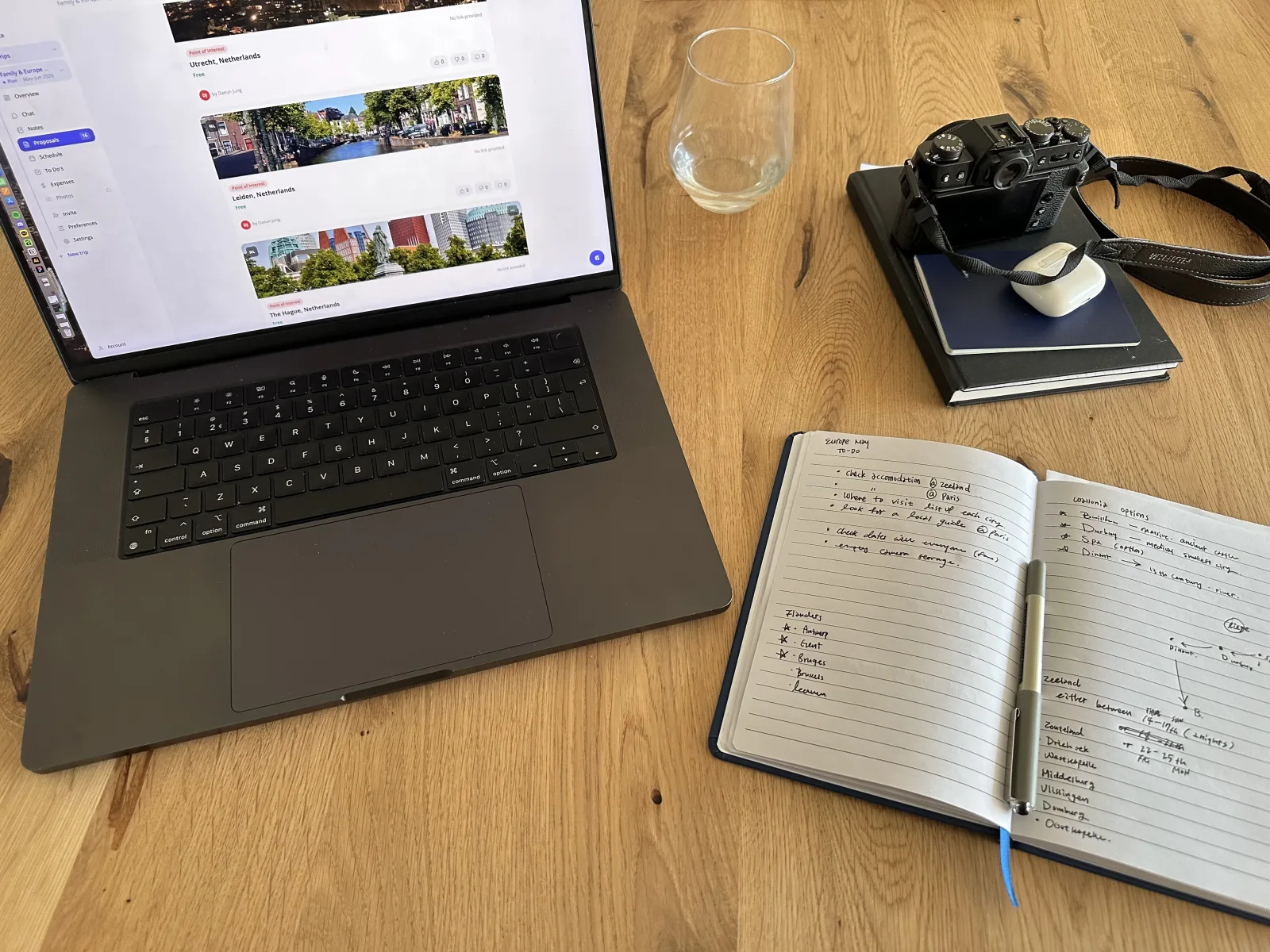
Before any decisions get made, give everyone a chance to propose what they actually want. The restaurant someone's been meaning to try. The day trip no one else has heard of. The afternoon where they just want to do nothing. Get it all in one place first, then decide together what makes the cut. The goal isn't to include everything. It's to make sure no one feels like their input never had a chance. People enjoy a trip more when they see at least some of their ideas in it.
Assign roles
Someone needs to own each piece: booking accommodation, checking visa requirements, tracking the budget, researching and building the itinerary. It doesn't need to be one person doing everything. In fact, it shouldn't be. Split it up based on who's good at what, or just who volunteers. What matters is that every task has a name next to it, not just goodwill and good intentions. We wrote a whole guide on how to split roles on a group trip, if this is the part your group keeps getting stuck on.
Use the voting system
Can't agree on two museum options? Vote. Torn between two itinerary days? Vote. The bigger the group, the more useful this becomes. Democracy isn't the most romantic way to plan a trip, but it's the one that actually gets you there. A simple thumbs up or thumbs down on a shared list moves faster than a 40-message debate and feels fairer to everyone involved.
Build a loose structure, not a minute-by-minute schedule
Over-planning is a real thing. A rigid itinerary breeds resentment when someone isn't feeling it on a particular morning. Instead, plan the non-negotiables — bookings, reservations, travel between cities — and leave the rest as suggestions, not obligations.
Globe
Handling money without the awkwardness
Money is awkward. Especially among friends. The goal isn't to eliminate money conversations. It's to make them quick, clear, and infrequent.
Agree on a system before you go
The three most common approaches are: one person pays for everything and settles up at the end, everyone pays their own share in the moment, or you pool a shared fund for group expenses. Each has tradeoffs. What matters is that everyone agrees on the same system upfront. Splitting costs on a group trip walks through all three and where each one starts to strain.
Track as you go, not at the end
Trying to reconstruct a week of shared expenses from memory at the airport is a recipe for disagreements and a bad last day. Keep a running log as you spend. A simple notes app works, but Globe has a built-in expense tracker where the whole group can log costs and see a running total together.
“Expenses always need to be tracked. Not because anyone is dishonest, but because things genuinely get forgotten, and forgotten expenses feel intentional in a way that tracked ones don't.
Give people an out on expensive activities
Not everyone can or wants to spend €200 on a Michelin-starred dinner. When planning activities with a wide price range, make it genuinely easy to opt out. Not just technically optional, but socially comfortable to skip. This is one of the most underrated things you can do for group harmony.
During the trip: keeping everyone happy

Even the best-planned trip runs into friction. Here's how to handle it when it comes.
Don't take things personally
This sounds obvious, but it's harder than it looks when you're tired, hungry, and slightly lost in an unfamiliar city. Not every mood is about you. Not every quiet moment is tension. Travel puts people in unfamiliar situations and strips away their routines, and people react to that differently. Give each other the benefit of the doubt. When something does need to be said, say it directly and listen with the same patience you'd want in return.
Let people split off
Not everyone needs to do everything together. Some of the best travel memories come from a morning where two people went to the market and two others slept in, and everyone reconvened for lunch. Splitting up isn't a sign the trip is failing. It's a sign everyone is comfortable enough to be themselves.
Default to whoever cares most
When the group can't agree on something in the moment, like where to eat or what to do next, default to whoever cares most. "I'm easy either way" is a valid answer, and the person with the stronger preference usually has a reason for it. Take turns, and it balances out over the trip.
When things go wrong, stay optimistic
No matter how well you plan, something will go sideways. A booking falls through. Someone gets sick. Two people have a disagreement that's been building since day one and finally surfaces over a missed train. This is not a sign of a failed trip. It's just travel.
A missed reservation becomes a spontaneous dinner somewhere better. A rained-out day becomes the afternoon everyone remembers most. The ability to reframe is a skill, and it gets easier the more you travel with the same people. Not everything can be predicted or prevented. The only thing you can control is how you respond to it.
After the trip: the part everyone skips
The flight home is not the end of the trip. There's the expense settling, the photo sharing, the inevitable "we should do this again" conversation that either gains traction or quietly fades.
Do the settling up before everyone disperses. It gets harder the longer you wait, not because anyone is avoiding it, but because life moves fast and the mental context disappears. Same with photos: one shared album, one link, sent within a week. After that, the chance of it actually happening drops significantly.
And if it was a good trip, say so. To the group, to the person who did most of the planning, to the friend who was quietly great company the whole time. It costs nothing and it makes the next trip more likely.
And if the planning itself felt harder than it should have, well, that's something we thought about a lot too. This is actually why we built Globe.
The Story Behind Globe
The four of us travelled together regularly, and for years our planning looked like this: a spreadsheet for the itinerary and accommodation, a group chat for decisions that never quite got made, Google Maps for saved locations, a Discord call for the big conversations, Google Drive for photos, and Splitwise for expenses. Six different tools, none of them talking to each other, and half the group barely keeping up with any of them. Someone would send a reminder and get silence. Someone else would do three hours of research and share it into the void. The frustration wasn't the traveling. It was everything that had to happen before we could leave.
We couldn't find one tool that handled all of it together, so we built it.
The tools that make it easier
Group trip planning has a coordination problem. Lots of information, lots of people, lots of decisions. And most people try to solve it with a group chat. Group chats are great for conversation. They're terrible for decisions.
What actually helps:
- A shared space where decisions and logistics live, not buried in a chat thread
- A way for everyone to propose ideas and see what others are interested in
- A voting system for destinations and activities, so one opinion doesn't dominate
- A simple expense tracker the whole group can see
- A shared notes space for research, recommendations, and reminders
- A shared photo album so the memories actually end up in one place
Globe is built specifically for this. It brings everything into one place: proposals, votes, itinerary, expenses, notes, and more. So the planning has somewhere to live that isn't a group chat. Your group chat can go back to being a group chat. It isn't the only option, and the others are stronger in different places — Globe, Wanderlog and TripIt side by side goes through what each one actually covers.
Before you go
Traveling with friends is worth all of it. The logistics, the compromises, the occasional friction. The trips you take with people you love become stories you tell for years. The planning headache lasts a few weeks. The memories last a lot longer.
That ski trip I mentioned at the beginning? We're trying again this year. This time, with a plan.
Start with the conversations. Be honest about what you need. Give everyone room to be themselves. The rest tends to sort itself out.
Globe
Plan your next trip with Globe!
Group trips are complicated enough. The planning shouldn't be.
Get Started