

Stop doing everything yourself: the best way to split roles on a group trip
One person always ends up planning the whole group trip. Here's how to split the work and plan a better trip with friends, without a group chat argument.

There's always one person. The one who spends a weekend researching accommodation, books the group flights at midnight because nobody else did, and keeps track of who's paid for what in a random notes app. Everyone else just assumes it's handled and waits for the trip to roll around. Planning an entire group trip by yourself is a lot to carry. If that's you, this one's for you.
It's not because everyone else is lazy. Everyone's busy with their own life, but more than that, nobody quite knows where to start. So everyone waits, assuming someone else will jump in first, until the trip is close enough that somebody finally has to. And it's usually the same person every time. We've written before about how to plan a group trip step by step, and step 3 in that guide is "assign roles, not just tasks." This article is that step, blown out into a full framework: which roles a group trip actually needs, and how to hand them out without it turning into another thing nobody responds to.
The roles every group trip actually needs
You don't need a formal org chart. You need four things covered, and four people who know they're covering them.
The four jobs, at a glance
Money person Tracks the budget and who's paid for what.
Itinerary person Turns the group's ideas into a plan everyone can see.
Logistics person Owns flights, accommodation, and getting between places.
Comms person Keeps people moving, and picks up whatever has no owner yet.
Money person. Tracks the budget, keeps an eye on who's paid for what, and flags it early if costs are creeping past what the group agreed on. If your group hasn't picked a system for splitting costs yet, this guide walks through the options.
Itinerary person. Doesn't need to come up with every idea alone, the whole group can throw in restaurants and activities. The job here is pulling it all together into an actual plan: not a minute-by-minute schedule, just enough structure that the group doesn't miss reservations. That includes keeping it somewhere everyone can see, so nobody's working off their own version of what's actually happening.
Logistics person. Owns flights, accommodation, and transport between places. It's also the role most dependent on everyone else: bookings need to actually get paid for, which means staying in sync with the money person so nothing falls through. It also needs to stay in sync with the itinerary person, especially if the group's moving between multiple cities or countries, since transport and accommodation have to actually line up with whatever's on the itinerary.
Comms person. Keeps the group chat from becoming the only source of truth. The most important part of the job: getting people to actually act on what's assigned to them, whether that's confirming a date, filling out a visa form, or sending their share of a deposit, instead of going quiet and assuming someone else will handle it. Also the natural person to pick up whatever doesn't have an owner yet, like tossing in an itinerary idea or looking into visa requirements, so it doesn't just sit there.
One person can hold two roles in a smaller group. The point isn't the exact headcount, it's that nothing is left as "everyone's responsibility," because in practice that means one person's. Some trips come with a default holder for all four — a bachelorette lands on the maid of honor whether anyone discussed it or not, which is exactly the case for handing them out on purpose. Planning a bachelorette trip covers that version.
“Nothing should be left as "everyone's responsibility," because in practice that means one person's.
How to actually assign them
Go by strength or interest, not by who's leading the conversation. The person who brings up planning the trip doesn't have to lead everything by default. The person who's already obsessively researching restaurants should be the itinerary person. Don't hand logistics to someone who hates admin. It'll just drag on, and that's the one role where dragging on actually delays the whole trip.
Make it official, not just implied. Agreeing on roles in the moment feels fine, but that sense of responsibility fades fast once everyone's back to their regular week. Give it a bit more weight than a passing comment, actually assign it with a due date, not just agree to it out loud. Roles need a place everyone can check back on, not just a memory everyone's relying on. Our group trip planning checklist covers this as part of the bigger pre-trip setup, worth a look if you haven't nailed down the basics yet.
Stay flexible if it's a recurring group. Being good at something once doesn't mean you're locked into that role forever. If the same six people take three trips together, it's worth checking whether the same person actually wants the same role again, rather than just assuming they will. Trading off takes the pressure off, and it's a lighter lift when nobody's carrying it every single trip.
Globe
Globe is a group trip planning platform built for exactly this: dedicated pages for to-dos, documents, expenses, and planning, so once roles are decided, everyone can actually work off them together, not just awkwardly asking in the group chat.
Common mistakes when splitting up the work
Assigning roles, then doing everyone else's job anyway. If you're still double checking every booking after handing off logistics, you haven't actually delegated anything. That defeats the point.
No clear deadline, so decisions just stall. A role nobody's actually acting on isn't much better than no role at all. It's easy to let it slide until the trip is two weeks out, and then everything gets crammed in at once, which is a lot more stressful than chipping away at it earlier.
Being too polite to push. Trip planning is never smooth, and chasing people down is part of it. Push for deadlines, just do it with respect, so whatever's waiting on that task doesn't stay stuck.
Roles that exist, but nobody else can see them. If the only record of who's doing what lives in one person's head, you're one missed reply away from nothing happening. Use a to-dos list, a shared note, or even just a quick update in the group chat, anything that makes progress visible to everyone, not just the person doing it.
How Globe makes this easier
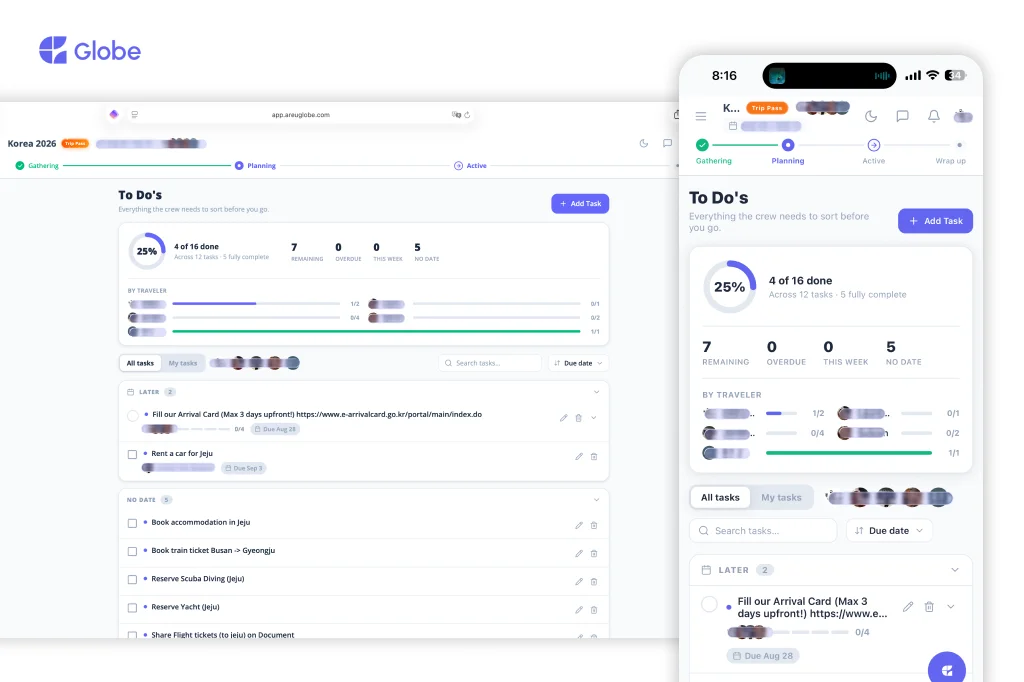
Instead of assigning roles in a group chat message that gets buried, Globe's To-dos page lets you assign specific tasks to specific people, each with a due date and a running tally of who's done what. Everyone can see exactly where things stand, on desktop or on their phone, without having to ask.
Story time
I'm in the middle of planning a Korea trip right now, multiple cities, which means train tickets, flights, a rental car, an international driver's license, a yacht day, and accommodation in three different places. Writing it all out like that made it obvious just how much there actually is to track, definitely not something one person should be carrying alone.
The screenshot above is our actual to-do list for that trip. Trip planning is easy to let slip between everything else going on day to day, but having it all sitting there means I don't have to hold it in my head. I just check the list.
FAQ
Who should be in charge of a group trip?
Nobody needs to be "in charge" of the whole thing. It works better split across a few roles (money, itinerary, logistics, comms) than concentrated in one person.
What if someone doesn't follow through on their role?
Give the role a visible home with concrete tasks attached, not just a broad label. Jobs often stall not because someone's lazy, but because the task feels too big and undefined, which makes it easy to put off. When something is stalled, mention them directly in the group chat instead of a vague "how's everything going" to the whole group. If it keeps happening, that's usually a sign the role wasn't visible enough to begin with, or wasn't the right fit for them.
What roles does a group trip actually need?
At minimum: someone tracking the money, someone building the itinerary, someone handling flights and accommodation, and someone keeping the group in the loop. In smaller groups, one person can cover more than one of these. See the full breakdown of each role for what each one actually covers.
What's the easiest way to keep track of who's doing what?
A shared, visible list beats a group chat every time. Whether that's a shared doc or an app like Globe, the key is that everyone can check it without having to ask.
Globe
Plan your next trip with Globe!
Group trips are complicated enough. The planning shouldn't be.
Get Started